

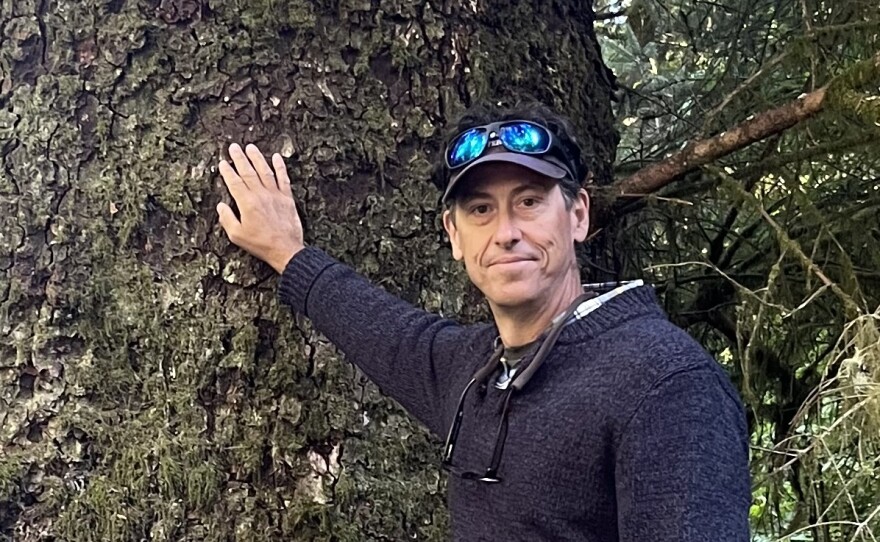
On a sunny April day, Paul Catanzaro, an extension forester at UMass Amherst, and NEPM’s Carrie Healy met to talk about his new book on ecological forestry, a land ethic that honors the forest. His book for landowners is called “Tending Your Forest.”
We’re walking into a forest in Plainfield, Massachusetts. It’s quiet here, but far from empty.
“This is what I would call an old forest. There is a critical mass of larger trees. It has a lot of downed dead wood, both standing snags. But down on the ground there was a wind disturbance here which allowed these young hemlocks at least get up into the lower canopy," Catanzaro said. "So, this is a complex forest. It’s tending to that old forest condition. And I don’t know, there’s just something special about that.”

It’s a stark contrast to what we see across the nearby brook, where the Franklin Land Trust is intentionally maintaining a pre forest condition. Why go to such lengths to create different stages of development?
“Because we need all four of those developmental stages pre forest, young forest, mature forest and old forest out on the landscape. 80% of vertebrate species use a combination of these,” he said.
Standing in a field nearby, it’s easy to see why our forests look the way they do. Most of Massachusetts forests are ecologically young, only 80 to 100 years old.
“We have this colonial land use history of very intensive agriculture that happened in a relatively short amount of time, and it was a complete removal of forests because it all started growing back at the same time," he said. "Many of our forests across the northeast are of similar age, similar what we would call structure. So, they’re missing some of the is what [Aldo] Leopold would call ‘some of the cogs in the wheels’, some of the parts within the forest. There is not a lot of dead wood.”
And structural diversity.
And that’s where ecological forestry comes in. In his guide titled “Tending Your Forest,” Catanzaro and coauthor Anthony D’Amato are aiming to help landowners navigate this. They begin by defining ecological forestry and how it’s different from standard forest management.
“Think of ecological forestry is an add-on to that. And so there are four principles to ecological forestry. There’s continuity, complexity, timing and context. And in using those or applying those principles, it’s possible to start restoring some of those cogs and wheels," Catanzaro said. "So, there is a dial for dead standing wood. There is a dial for dead down wood. There’s a dial for greater, larger trees that are retained. There’s a there’s a dial for other attributes. And you can move those dials up and down based on the unique attributes of the forest and the landscape in which it’s embedded, as well as the landowners goals.”

Back in the old forest, we’re looking at a fallen log covered in lush green moss. He points out a tiny hemlock seedling growing right out of it.
“Right behind us, this [is a] beautiful example of down dead wood. So, we call those logs nurse logs. The more dead wood you have in here, not only is there a benefit to that for insects and salamanders and bears that might forage for ants and things, but it’s also aiding in regeneration. That is what resilience is… it’s about diversity.”
It’s a lot to think about for a family landowner. Many people feel a sense of guilt, like they’re not doing enough or that their land isn’t perfectly managed.
“My advice would be take the pressure off yourself. You know, I think the first thing to recognize is the most important thing we can do is keep forests as forests," he said. " All of the benefits that come from forests, whether it be climate change mitigation, clean water, biodiversity, wood products, recreational or spiritual renewal, all of those things depend on actually having forests.”
"We need to think about a different relationship, a different way of interacting with our forests"
- forester Paul Catanzaro
So, if a landowner wants to start, where do they begin?
“If there was one thing I could wave my magic wand and ask people to do would be to engage with their forest, to establish a relationship," he said.
Catanzaro added that the most important thing you can do is, "get out there."
"Whether it be walking, whether it be working with mushrooms, whether it be wildlife habitat, pulling invasive plants, whatever it is for you that inspires you, just engaging with your forest, creating that relationship, that land ethic, that sense of reciprocity is the first step on a longer journey," he said. "And once you’ve established that relationship, quite often, the next logical steps unfold. And we need to think about a different relationship, a different way of interacting with our forests and for different people that looks differently, right?”
It’s a powerful reminder. The future of the forest isn’t just in the hands of the government or of big timber companies. It’s literally in the hands of the individuals who call western Massachusetts home.
Catanzaro and Anthony D’Amato’s book, written for landowners, is called “Tending Your Forest: A Guide to Ecological Forest Stewardship.”
Paul Catanzaro is a Professor of Forest Ecology and Silviculture at the University of Massachusetts. He serves as the State Extension Forester and Co-directs the Family Forest Research Center, a partnership between the USDA Forest Service and UMass.